
The key elements of a modern sun shading control system
Sun shading control systems usually coordinate all sun shading installations in the building.
To this end, globally standardized and recognized systems such as KNX, LON and
BACnet are often used. If the SMI, developed specifically for sun shading requirements, is used as a
sub-bus system in addition to the aforementioned systems, the result is an optimized installation.
Before selecting the SMI control unit, the drive type must be clarified. The sun shading manufacturer
can provide the necessary information. Tubular drives or venetian blind drives may be
used.
When using SMI drives, a major advantage is the option of
parallel connection. Depending on the control unit, up to 16 drives can be connected to one control unit channel.
Control units, which provide control for the drives, are available with one or
multiple channels.
The functions
The automation system evaluates the electrical signals from sensors (brightness, wind,
precipitation, temperature, etc.) and controls the automated sequences.
The most important functions of sun shading automation in accordance with VDI Guideline 3813-2 are:
- Slat tracking (glare protection and energy optimization)
- Shading correction (energy optimization)
- Weather automation (product protection)
- Thermal automation (energy optimization)
- Time programs (automation of repetitive tasks)
- Shock automation (burglary protection)
Joint operation of all sun shading installations, or those within a sector, is also carried out
via the automation system. The main central operating actions are:
- Move sun shading to the desired position
- Switch automation functions on or off
- Activate or deactivate locks
- Read information
Sun shading control for multiple sectors
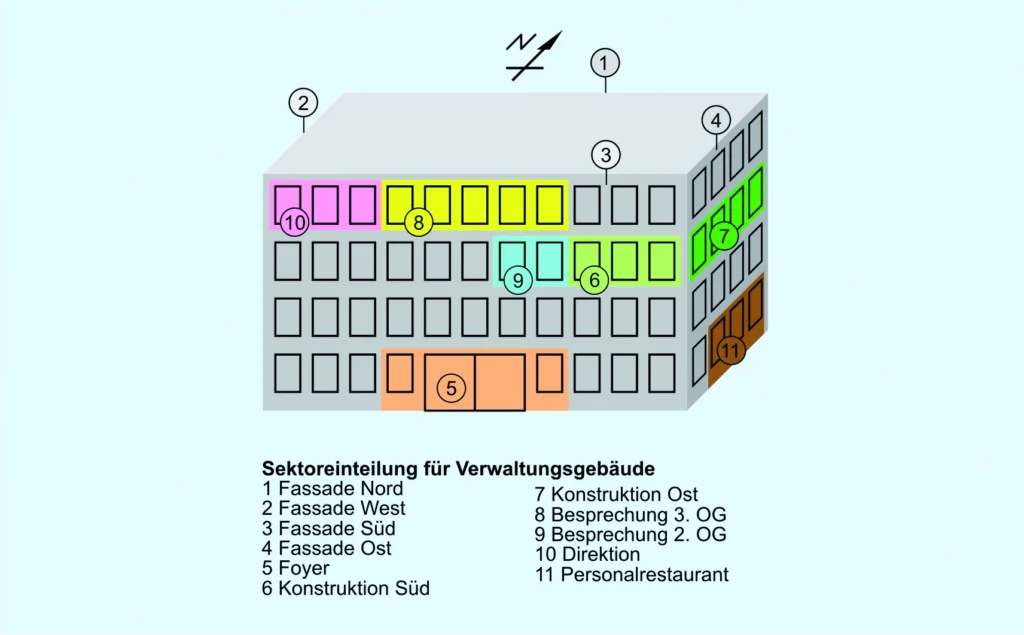
Some commercially available sun shading control systems are designed for a single installation or a
single sector. Common examples are awning controls. For a house or
a building, division into multiple sectors is essential, because the requirements
for automation vary greatly. For example, the staff restaurant
requires different time automation than the executive office, or the design department has different
requirements for glare protection than the meeting room. Sun shading installations on a
facade, a floor, a room, or a single sun shading installation are assigned to a sector
depending on use. During planning, areas with the same use
or the same control requirements must be identified.
For an administrative building, for example, the following sectors should be defined:
- per facade
- per façade section with the same sun exposure conditions
- for rooms with special shading requirements
- for a meeting room
- for the foyer
- for the staff restaurant
- for awnings on the roof terrace
- etc.
The more sectors* are defined, the more flexibly a control system can be adapted to the
building. However, the increasing degree of complexity and the
increasing configuration effort must also be noted.
SMI for room- or segment-oriented building automation
Sun shading installations with SMI drives, together with the new SMI control units,
support room- or segment-oriented building automation in an ideal way.
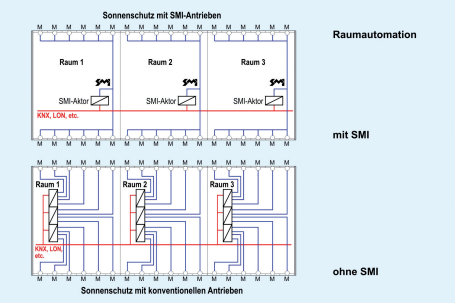
An interesting example of the wide range of applications of the SMI interface can be seen in the image
“Room automation”. With this type of building automation, only one
SMI control unit with SMI interface is required per room. Depending on the product, up to 16 drives
can be connected to one SMI interface. A similar situation applies to axis-flexible
building automation in office buildings, where one control unit controls the drives of up to 16 axes.
In the STANDARD MOTOR INTERFACE, leading specialist companies have contributed their expertise to a
practical and forward-looking system that has already proven itself
in the market.
* In the planning methodology of VDI 3813, sectors correspond to the term “area”.
Cost, installation time and space savings
The STANDARD MOTOR INTERFACE enables the electrical parallel connection of up to
16 drives. The addressing system has the capability to address each drive separately
to be able to. This feature enables new installation concepts with significantly lower
costs, shorter installation time and considerable space savings. Previously,
a separate control section with its own drive connection was required for each drive.
For the parallel connection of a maximum of 16 drives, modern flat cable systems are suitable, among others,
which do not require installation boxes for branch-offs. Installation time is
significantly reduced by these installation systems. It also makes it possible to
control up to 16 drives precisely with a single penetration
of the building envelope and parallel external cabling.
SMI for smart room automation
The advantages of products with the SMI interface are obvious. Both the
control technology and the drive technology benefit from the established technology.
For example, multiple roller shutter or venetian blind drives can be connected in parallel
to SMI control units. The drives have new, manufacturer- and customer-friendly
features. They are more precise, report operating status and, depending on the product,
offer innovative protective functions. Everyone benefits: end customers, planners,
installers and manufacturers.